Datong / Liao-Jin
Huayan Temple
A major Datong temple whose Liao-Jin halls and sutra-storage culture show the city's Buddhist and imperial afterlives.
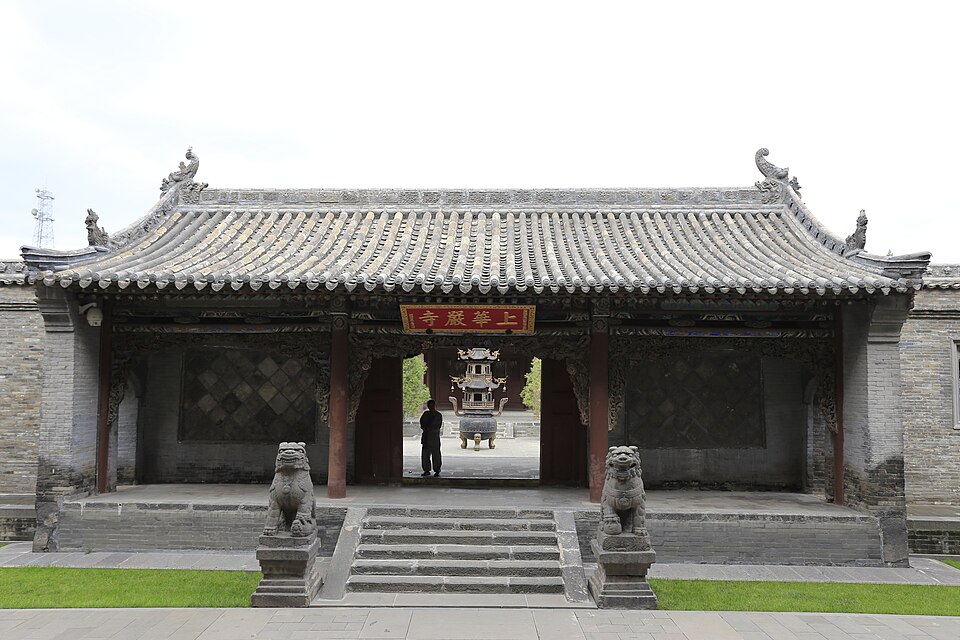
Why it matters
Huayan Temple belongs in ChinaEaves because it makes one part of Shanxi's heritage legible without flattening the province into a checklist. It is a Datong Liao-Jin Buddhist monastery, but the more useful description is the one a careful visitor can test on site: the Datong page that connects Yungang's stone world to timber and ritual space. The page therefore treats the monument as evidence, not as decoration around a travel itinerary.
The basic facts are intentionally stable. The site is in Datong, the portfolio frame records it under Liao-Jin, and the heritage field identifies it as First-batch national protected site, no. 1-0091-3-044. Those labels are not enough by themselves, but they prevent the page from drifting into vague wonder-writing. They give the visitor a set of claims that can be checked against the source list below.
What makes the place durable is urban monastic scale and northern dynastic layering. A visitor may arrive because a game, a video, or a photograph created curiosity, but the deeper value appears when that first impression is slowed down. ChinaEaves uses the attention wave as an entrance, then asks the reader to look for structure, sequence, material, and conservation rather than only for resemblance to an image online.
This page cites 4 source records, including national heritage registration and specialist or official references.
Historical and architectural frame
Read the monument first as a built argument. Its date label points to Liao-Jin, but a dynasty name is only a beginning. The important question is how an inherited building language solves a local problem: cliff, courtyard, hall, tower, image, or route. In this case the working frame is the Datong page that connects Yungang's stone world to timber and ritual space, and that frame is visible before any caption explains it.
The heritage status matters because it changes the visitor's responsibility. A nationally protected or World Heritage-linked place is not simply an attraction with old surfaces. It is a site where repair, crowd pressure, photography, and interpretation can affect the object people came to admire. The page keeps that distinction in view so that admiration does not become consumption.
Shanxi rewards comparison. A timber hall should be compared with another timber hall, a sculpture interior with another sculpture interior, and a route stop with the travel rhythm around it. Huayan Temple is strongest when it is not isolated from the other eleven pages. Its role in the collection is to make urban monastic scale and northern dynastic layering readable beside caves, pagodas, shrines, and temple compounds.
The source base also shapes tone. UNESCO pages, national heritage registries, official scenic sources, museum texts, and specialist architecture archives do not all answer the same question. Together they make the page cautious: one source may establish designation, another may clarify architectural type, and another may help explain why this place now appears in Black Myth-era travel conversations.
How to look on site
Start with distance. Before moving toward details, ask how the site announces itself: as cliff profile, roof mass, tower silhouette, gateway, courtyard, or interior density. For Huayan Temple, the first reading should be axis, rebuilt layers, older halls, and the sense of a monastery embedded in the old city. This keeps the visit from beginning with a phone camera and ending before the eye has adjusted.
Then move from large form to load path. Roofs, beams, brackets, cave thresholds, walls, or platforms are not neutral background. They direct weight and attention at the same time. Even where the visible drama is sculpture, the question remains architectural: where does the force go, how is the view framed, and what does the visitor's body have to do to understand the space?
Look for repetition with variation. Shanxi monuments often become legible through repeated eaves, bays, images, platforms, or figure groups. The novice sees abundance; the better reader asks what changes from one bay to the next. That method works especially well here because urban monastic scale and northern dynastic layering can otherwise overwhelm the viewer into treating all surfaces as equal.
Finally, notice the limits of access. Some things are visible only from a fixed path, behind a barrier, from a doorway, or in controlled light. That is not a failure of the visit. It is part of the conservation contract. The page deliberately emphasizes what can be learned without touching, crowding, climbing, or treating a sacred or protected surface as a prop.
Black Myth context
use the visual familiarity as an entry point, then return to Liao-Jin architecture. That sentence is the editorial rule for this page. ChinaEaves names the Black Myth context because it is a real path by which many readers now discover Shanxi, but it does not convert the monument into a game supplement. The cultural object remains the primary subject.
This distinction affects language. The page avoids phrases such as official guide, authorized partner, or official filming location unless a Tier-1 source states them directly. Instead, it speaks about attention, resemblance, travel curiosity, and source-grounded links. That caution is not timid; it is what lets the page remain useful after the current entertainment cycle fades.
The better question is not whether a visitor can find a one-to-one game image. The better question is what the game-age eye is now prepared to notice: density, age, mass, color, theatrical height, cliff engineering, or a disciplined sequence of halls. Huayan Temple earns its place because it can survive that question without depending on the game for meaning.
For international readers, this framing is especially important. A fast viral label can make every site sound like a film set. A slower explanation shows why Shanxi was visually powerful before the game and why it remains worth studying after the game. That is the durable brand ChinaEaves is trying to build.
Route logic
Huayan Temple is not just a dot on a map. It functions as a walkable Datong stop that pairs naturally with Shanhua Temple. The visitor who understands that role can avoid the common mistake of stringing famous names together without thinking about fatigue, daylight, transport, and the kind of attention each stop asks for.
The route pages therefore use sequence as interpretation. A cave temple before a timber hall changes what the visitor sees in the hall. A sculpture interior after a city wall changes what the visitor expects from a room. A shrine or Taoist temple near the end of a Buddhist-heavy route changes the tone of the journey. Huayan Temple contributes one of those shifts.
For planning, the useful unit is not only distance. It is mental bandwidth. A site with dense sculpture or complex structure may need fewer kilometers and more quiet time. A site with a strong exterior silhouette may work better earlier in the day. A site embedded in an old city can pair with another walkable stop, while an outlying site may deserve its own margin.
That is why the generated maps are deliberately simple. They locate the place in Shanxi without pretending to replace local transport information, ticket rules, weather, or conservation notices. The static route is an editorial scaffold. Before an actual visit, readers should still check official opening and access information through current local channels.
Responsible reading
The page is source-grounded, but it is not a final scholarly monograph. It is a public entry point that names sources, states uncertainty conservatively, and gives non-specialists a way to look. The claim panel separates a small set of verifiable statements from broader interpretation so the reader can see which sentences carry factual weight.
Images are treated the same way. The displayed photograph is recorded in the image-license registry, and the local locator graphic is generated by the site. ChinaEaves does not use game screenshots, character art, store assets, or unlicensed press images. That constraint keeps the visual surface quieter, but it also keeps the project legally and editorially cleaner.
The right outcome is not a visitor who memorizes every label. The right outcome is a visitor who can stand before Huayan Temple and ask better questions: what is carrying weight, what is original or restored, what is being protected, what is being dramatized, and what source would prove the claim I am about to repeat?
That habit scales beyond one monument. Once a reader learns it here, the same method can be carried to the other ChinaEaves pages: compare source tiers, read the route, slow down before photographing, and let the building or sculpture answer before importing a ready-made story from social media.
Verifiable notes
Huayan Temple in Datong is a first-batch national protected cultural relic site.
Huayan Temple preserves important Liao-Jin architectural context in Datong.